If you ask three different contractors what the best resurfacing material is for a Florida pool deck, you will likely get three different answers. The truth is that there is no single best material. The right solution for a shaded screened lanai in Sarasota is often completely different from what works on a full-sun pool deck in Orlando. Florida’s humidity, rain, pool chemicals, drainage conditions, and even groundwater levels can dramatically affect how resurfacing materials perform.
Many resurfacing projects fail, not because the material itself was defective, but because it was chosen without considering the environment it had to survive in. In this guide, we will explore why pool deck resurfacing in Florida projects fails, what conditions contribute to those failures, and how you can choose resurfacing systems built for long-term performance.
Key Takeaways
|
Why Most Florida Pool Deck Resurfacing Projects Fail Within a Few Years
You might think a new finish will last a decade, but without the right plan, you could be looking at repairs within two years. Most failures come down to a breakdown in the bond between the new material and the existing pool deck surface.
Moisture Trapped Beneath the Surface
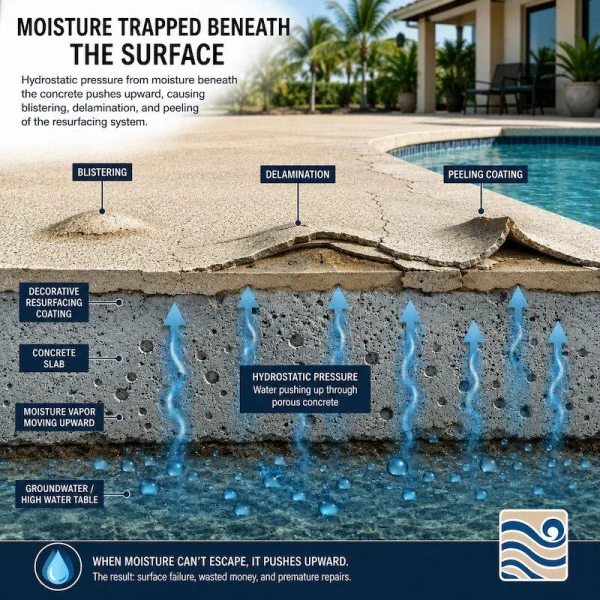
When moisture gets trapped under a coating, it creates hydrostatic pressure. As the water tries to escape through the porous concrete, it pushes against your new finish, causing delamination, blistering, and peeling.
Existing Concrete Problems Were Never Addressed
If your concrete slab has structural cracks, spalling, or a weak top layer, a new coating will only hide these issues temporarily. Eventually, the movement in the concrete will be reflected through the new surface.
The Wrong Material Was Used for the Environment
A material that works in a dry climate might fail in a humid one. Pool deck resurfacing options must account for constant splash-out, salt or chlorine exposure, and the lack of airflow in screened lanais.
Poor Surface Preparation Before Installation
Proper surface preparation is the most important step. If the concrete isn’t ground down or cleaned to open the pores, the new material won’t have a solid “tooth” to grab onto. Skipping this labor-intensive step is a recipe for disaster.
Many failures blamed on materials are actually caused by poor preparation or installation mistakes. Understanding the most common pool resurfacing mistakes can help homeowners avoid premature failure.
The Florida Conditions That Cause These Failures
Living in Florida means dealing with a unique set of environmental stressors. Our high water table and intense humidity create a constant cycle of moisture that is always pushing against your concrete pool decks.
Florida’s High Humidity Creates a Constant Moisture Cycle
Daily condensation and high ambient humidity mean your deck never truly dries out. If your coating isn’t moisture-resistant and breathable, water vapor will stay trapped, leading to mold growth and eventual coating failure.
Florida’s humidity and frequent rainfall create conditions where moisture can remain trapped beneath the surface. Over time, this constant exposure can accelerate wear, cracking, and surface deterioration—one of the primary reasons concrete deteriorates faster in Florida.
Florida’s High Water Table Can Push Moisture Up Through Concrete
In many parts of the state, the water table is just a few feet below your home. This leads to moisture vapor transmission, where water is forced upward through the concrete slab by hydrostatic pressure. A resurfacing material that lasts 10 years in a dry climate may struggle much sooner in Florida because the concrete underneath is exposed to significantly different moisture conditions.
Pool Splash-Out and Chemical Exposure
Constant exposure to chlorine or salt water can chemically degrade inferior coatings. You need a material that can handle these harsh weather conditions and the repeated wet-dry cycles of a busy pool area.
Warning Signs Your Existing Pool Deck May Need More Than a New Coating
Before you start your resurfacing project, you need to know if the underlying concrete is healthy. If you skip this, your new finish will likely fail.
The Simple Tap Test
You can check for hidden damage yourself using the “tap test.” Take a heavy metal rod or even a golf club and tap the surface of your concrete. If you hear a sharp, solid “clack,” the concrete is likely sound. If you hear a dull, hollow “thud,” it means the top layer of concrete has separated from the base. This is called delamination.
|
Warning Sign |
What It Means |
Required Action |
|
Hollow Sounds |
Subsurface separation or “drummy” concrete. |
Mechanical removal and patching. |
|
Active Cracks |
Structural movement or settlement. |
Crack injection and structural repair. |
|
Damp Spots |
Poor drainage or high moisture vapor. |
Install a moisture vapor barrier. |
|
Peeling Paint |
Old, incompatible coatings. |
Full grinding to remove old coatings. |
What Makes a Resurfacing Material Perform Well in Florida?
To achieve excellent durability in the Sunshine State, your chosen system must meet specific performance standards.
-
- Moisture Resistance: Must allow moisture vapor to pass through without blistering.
-
- Strong Bonding Performance: High-solids base coats ensure the material stays locked to the concrete.
-
- Slip Resistance: Surfaces must remain slip-resistant even when covered in water.
-
- Heat Reduction: Cool deck properties are essential to keep the surface comfortable for bare feet.
Because moisture is one of the leading causes of resurfacing failures in Florida, protecting the underlying concrete is just as important as selecting the right finish. Proper waterproofing of concrete surfaces can significantly reduce moisture-related failures and extend the lifespan of outdoor concrete.
The Best Resurfacing Systems for Florida Pool Decks and Patios
Choosing between various textures and material types can be overwhelming. Here are the most effective pool deck resurfacing options for our climate.
Polymer-Modified Concrete Overlays
These are high-strength cementitious products that provide excellent durability. They are perfect for stamped concrete pool decks because they can be textured to look like stone, tile, or brick. When installed correctly, they are incredibly strong and moisture-tolerant.
Acrylic-Based Cool Deck Systems
If your main goal is keeping the deck cool, acrylic spray-texture systems are the standard. They are designed to absorb heat less than standard concrete and provide a non-slip, rough texture that is safe for heavy foot traffic.
High-Performance Polyaspartic Coatings
For the ultimate in longevity, modern concrete coatings like polyaspartic resins are becoming the go-to for commercial property owners and luxury homes. Unlike older epoxies, these are UV-stable (they won’t yellow) and highly resistant to chemicals.
Why Pool Decks and Patios Often Require Different Resurfacing Solutions
It is a mistake to treat every outdoor surface the same. A pool deck resurfacing job in a screened lanai has different needs than an open-air pool deck.
Challenges Unique to Pool Decks
-
- Splash-out: Constant water exposure requires a fully waterproof or highly moisture-resistant seal.
-
- Barefoot Traffic: Surfaces must be slip-resistant but not so abrasive that they hurt your feet.
Challenges Unique to Covered Patios and Lanais
-
- Trapped Humidity: Because these areas have less airflow, they stay damp longer.
-
- Mildew Growth: You need a finish that resists mold and is easy to clean.
Questions Florida Homeowners Should Ask Before Choosing a Resurfacing Contractor
Before you place your signature on a contract, ask these critical questions to ensure your investment lasts:
-
- Has the existing concrete been evaluated for moisture issues? If they don’t mention moisture testing, they might be ignoring a major failure point.
- How is surface preparation performed? Look for contractors who use industrial grinders rather than just acid washing.
- Which resurfacing system fits my environment best? Ensure they aren’t just pushing one “favorite” product for every job.
- What steps help prevent future moisture-related failures? Ask about vapor barriers or breathable sealers.
How Creative Resurfacing Solutions Helps Homeowners Avoid Premature Resurfacing Failures
With Creative Resurfacing Solutions, they don’t just apply a new layer of material. They provide a complete diagnostic and installation service. They are well aware of the unique challenges of the Florida climate, from the humidity in Clearwater to the salt air in Sarasota.
-
- Comprehensive Surface Evaluation: Checks for structural integrity and delamination.
-
- Moisture and Condition Assessment: Ensures the slab is ready to receive a new finish.
-
- Environment-Specific Material Recommendations: Choose the system—acrylic, polymer, or polyaspartic—that best fits your specific site.
-
- Professional Surface Preparation: Uses the right tools to ensure a permanent bond.
-
- Long-Term Protection Strategies: Apply high-quality sealers to keep your deck looking new for years.
Most Florida pool deck resurfacing failures are not caused by bad luck. They are often the result of moisture issues, environmental conditions, improper preparation, or choosing a resurfacing system that was not suited to the space. By understanding the factors that affect performance and selecting materials based on real-world conditions rather than trends, you can achieve longer-lasting results and avoid costly repairs down the road.